// All posts
← homeWhat are HTTP Client Hints?
HTTP Client Hints (client hints) are a web browser mechanism that transmits information about the capabilities and limitations of…
What is entropy?
Entropy is a concept from information theory and statistics that is used to measure the degree of uncertainty or disorder in a sy…
Accept - HTTP header, what is it for and how does it work?
Accept is one of the HTTP headers. It is used to indicate to the server which types of objects (media, etc.) the client can proce…
What are Quality values (quality values / priority) in HTTP?
Quality values (quality values / priority) are numerical values used in HTTP headers to determine the relative quality or priorit…
What is Routing?
Routing (routing) is a key stage in the process of directing network traffic to its destination. It plays an important role in bo…
What is the purpose of the HTTP TRACE method?
The HTTP method TRACE is intended for diagnosing the path that a request has taken to the server. When a client application sends…
What is the difference between the PUT and PATCH HTTP methods?
The main difference between the PUT and PATCH methods lies in the amount of data sent to the server and their behavior. The PUT m…
What is the HTTP PUT method used for?
The HTTP method PUT is used to update an existing resource on the server or to create a new resource if it does not already exist…
What is the purpose of the HTTP POST method?
The HTTP method POST is used to send data to the server for processing or storage. This method allows the client to create new re…
What is the purpose of the HTTP PATCH method?
The HTTP method PATCH is used for partial updates of a resource on the server. This method allows the client to send only the par…
What is the HTTP OPTIONS method used for?
The HTTP method OPTIONS is used to obtain information about the capabilities of the server or the parameters supported for a spec…
What is the HTTP HEAD method used for?
The HTTP method HEAD is used for retrieving headers of the server's response to a request without a response body. The main diffe…
What is the purpose of the HTTP GET method?
The HTTP method GET is used to retrieve data from a web server. When you make a request with this method, you are asking the serv…
What is the purpose of the HTTP DELETE method?
The HTTP method DELETE is used to delete a resource (the definition of a resource is a bit further down) on a web server. This me…
What is the HTTP Connect method used for?
The HTTP method Connect is used to establish a tunnel between the client and the server through a proxy server.This method allows…
What is a Packet in IT?
The concept of packet in computer science refers to a unit of data that is transmitted over a network. Each packet contains two m…
What is a Webserver and an Application Server?
Web Server - is software responsible for receiving and processing HTTP requests from clients (such as web browsers) and serving s…
What is CSR (Client Side Rendering)?
CSR (Client Side Rendering) – is a web rendering technique where content is generated on the client side, that is, on the user's …
What is SSR (Server Side Rendering)?
SSR, or Server Side Rendering, is a technique used to generate HTML content on the server and send pre-built pages to clients. Th…
What are Environment Variables in software development?
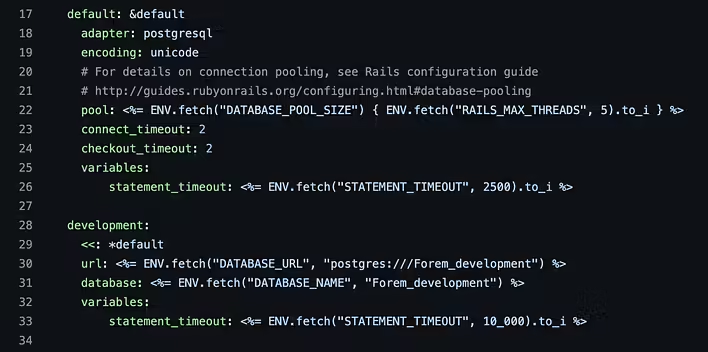
Environment Variables (Environment Variables) are configuration settings that are stored at the operating system level (for examp…