Table of contentsClick link to navigate to the desired location
What does the label "Created with AI" meanWhere can such labeling be seenWho adds the label: the author or the platformDoes the label mean that AI created all the materialHow the platform determines the origin of contentCan the label appear by mistakeDoes such labeling reduce reachCan the labeling be trustedWhat is AI (artificial intelligence)A brief history of the development of artificial intelligenceHow artificial intelligence works in simple termsWhere AI is used todayInformation searchText and image creationSmartphonesOnline storesBankingMedicineCars and transportationContent recommendationsWhat AI can and cannot doHow artificial intelligence differs from generative AIFrequently Asked Questions (FAQ)Is AI and ШІ the same?What does AI Generated mean?Can AI make mistakes?Can content created by AI be used?Will artificial intelligence replace humans?Can it be determined if a text or image was created by AI?
This content has been automatically translated from Ukrainian.
What does the label "Created with AI" mean
The phrase "Created with AI," "Generated by AI," or AI Generated indicates that generative artificial intelligence was used during the creation or substantial editing of the material. This labeling can be seen next to photographs, videos, audio recordings, and social media posts.
The label does not necessarily mean that AI independently created all the material. It may have generated images from scratch, added a specific object, replaced a background, synthesized voice, or significantly altered a video. The final result could have been edited by a human.
In Polish-language interfaces, similar labeling may appear as Treść utworzona przez SI, Utworzone przy użyciu SI, or Wygenerowane przez SI. The Polish abbreviation SI stands for sztuczna inteligencja, meaning artificial intelligence.
Where can such labeling be seen
AI usage labels are added by social networks, video platforms, graphic editors, and other online services. Their name and design depend on the specific platform.
On Facebook, Instagram, and Threads, information about AI may appear next to images, audio, or videos created or significantly altered by generative tools. YouTube also labels realistic videos and audio recordings that were generated or significantly changed using AI.
The purpose of such labeling is to help users understand the origin of the material. This is especially important when a generated image or video can easily be confused with a real recording of an event.
Who adds the label: the author or the platform
The label can appear in several ways.
Sometimes the author themselves indicates that they used generative AI. On some platforms, the relevant option must be selected during the publication of the material.
The labeling can also be added automatically if the images or videos were created using the platform's built-in generator. In this case, the service already has information about the origin of the material.
Another source of information is the technical data attached to the file. They may contain information about the program or model used to create or edit the material. The platform reads this data and displays the corresponding message to users.
In some cases, the service may apply the labeling according to its own rules. The exact mechanism depends on the platform, so the same file may be displayed differently across various social networks.
Does the label mean that AI created all the material
Not always. There are many intermediate options between full generation and ordinary manual editing.
A person could:
- create an image based on a text description;
- generate only the background or a specific object;
- extend the boundaries of a photograph;
- remove or replace an object;
- synthesize voice;
- change a person's face or movements in a video;
- use AI to create a draft and then revise it independently.
In all these cases, the platform may report the use of artificial intelligence. The label itself usually does not indicate which specific part of the work was done by AI and how significant its involvement was.
Therefore, the phrase "Created with AI" is better understood as a notification of the use of the relevant technology, rather than a statement that a human did not participate at all in the creation of the material.
How the platform determines the origin of content
One of the mechanisms is metadata. This is additional information stored in the file: creation date, program name, camera settings, and other technical details.
To verify the origin of digital materials, the C2PA standard and Content Credentials technology are also used. This allows secure information to be added to the file about where and with which tools it was created or modified.
In this case, the platform does not just try to recognize a generated image by external signs, but obtains technical information about its origin and editing history. However, not all programs and services support this technology.
Some technical data may disappear during re-saving, format changes, screenshot creation, or transmission through a service that removes metadata. Therefore, the absence of labeling does not necessarily prove that AI was not used.
Can the label appear by mistake
Yes, although often the problem lies not in an outright mistake, but in overly broad wording.
For example, a photographer might take a regular shot and then use a generative tool to remove an object from the background. The platform sees information about the use of AI and adds the label, although the basis of the material remains a real photograph.
That is why some services use more neutral wording like "Information about AI." They report the application of the technology but do not claim that all the material is completely generated.
If the author believes the labeling is incorrect, it is worth checking the rules of the specific platform and available ways to appeal. Intentionally removing technical data to hide the use of AI is not advisable: some platforms require reporting realistic content that has been generated or significantly altered.
Does such labeling reduce reach
The mere fact of labeling does not necessarily mean punishment or limitation. For example, YouTube states that reporting the use of altered or synthetic content does not in itself reduce the audience of the video or deprive it of monetization opportunities.
On other platforms, the rules may differ. The spread of a post is influenced by its content, audience reaction, adherence to community guidelines, and the operation of recommendation algorithms. Therefore, it is not advisable to automatically explain low reach solely by the appearance of the AI label.
More serious consequences may occur when an author hides the use of generative technologies in realistic material that can mislead people or violates other platform rules.
Can the labeling be trusted
The label provides useful information but is not infallible proof. If it is present, it usually means that the author, program, or platform reported the use of AI at one stage of the material's creation.
The absence of a label also does not definitively prove anything. Technical data may not have been preserved, the author may not have reported the use of AI, and the platform may not have recognized the origin of the file.
When evaluating a suspicious photo or video, it is important to consider not only the labeling but also the source of publication, context, date, reliability of the description, and the presence of confirmations from other sources. Special caution should be exercised with materials that allegedly show extraordinary events, famous people, or statements that could influence important decisions.
What is AI (artificial intelligence)
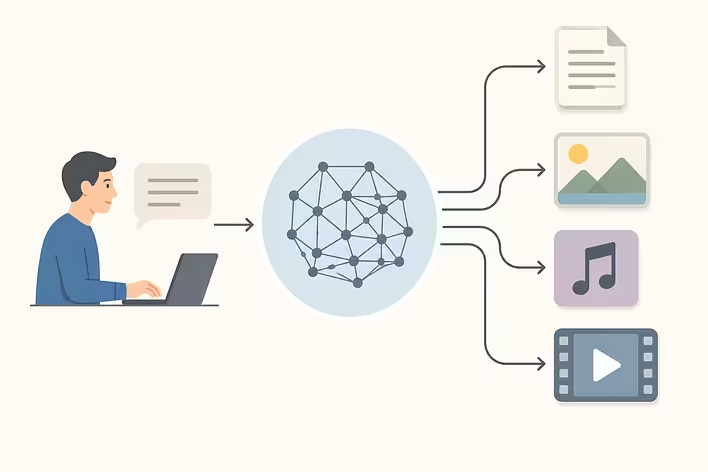
AI (artificial intelligence, English Artificial Intelligence, or AI) is a technology that allows computers to perform tasks that previously required human thought. It helps programs analyze information, find patterns, recognize images and speech, translate texts, answer questions, create images, write code, and even generate videos.
Despite its name, modern artificial intelligence is not an "intelligent machine" in the sense often portrayed in science fiction films. It does not possess consciousness, personal desires, or emotions. Instead, AI operates through mathematical models that have learned to find patterns in vast amounts of data and use them to perform specific tasks.
If previously most programs operated under clearly defined rules ("if A happens — do B"), modern AI can learn from examples. For instance, to teach a system to recognize cats in photographs, a programmer does not need to describe the shape of ears, the length of tails, or the color of fur. It is enough to show the model millions of photographs labeled "cat" or "not cat," after which it will learn to find characteristic features on its own.
That is why artificial intelligence is capable of performing a wide variety of tasks:
- answering questions and engaging in dialogue;
- writing texts;
- translating into various languages;
- creating illustrations;
- generating music and videos;
- analyzing large datasets;
- assisting with programming;
- recognizing objects in photographs and videos.
In recent years, AI has been talked about much more frequently than ever before. The reason is simple: the technology has become accessible to ordinary users. If previously artificial intelligence was primarily used within large companies, now almost anyone can use it through online services or mobile applications.
That is why it is increasingly common to see phrases like "created with AI", "generated with AI", or "AI Generated". What they mean and whether all such content is entirely created by computers will be explored further.
A brief history of the development of artificial intelligence
Although artificial intelligence has only been actively discussed in recent years, the idea itself has existed for over half a century. The term "artificial intelligence" (Artificial Intelligence) was proposed by American scientist John McCarthy in 1956 during a scientific conference at Dartmouth College. This event is considered the beginning of AI development as a separate field of science.
The first artificial intelligence systems were quite simple. They could solve mathematical problems, play simple games, or operate under predefined rules. Due to limited computing power of computers and a lack of data, progress was slow, and at certain periods, the development of the technology nearly halted. These phases even received the name "AI winters" — times when interest in AI and funding for research significantly decreased.
A new phase began in the 21st century when computing power of computers significantly increased, large datasets became available, and machine learning methods became much more effective. As a result, artificial intelligence began to be actively used for speech recognition, text translation, image analysis, recommendation systems, and many other tasks.
A real surge in popularity occurred at the end of 2022 after the emergence of ChatGPT — one of the first generative AI services that became available to the general public. It demonstrated that artificial intelligence can engage in natural dialogue, write texts, assist with learning, programming, and creative tasks. Since then, large technology companies have rapidly begun to integrate generative AI into search engines, office programs, graphic editors, smartphones, and other digital services.
Today, the development of artificial intelligence continues at an extraordinarily rapid pace. Almost every month, new models and tools emerge that expand the capabilities of this technology and gradually make it a familiar part of everyday life.
How artificial intelligence works in simple terms
The principle of modern AI can be explained without complex mathematical terms. To simplify greatly, artificial intelligence learns from a vast number of examples, finds patterns in them, and uses them to perform new tasks.
For example, language models like ChatGPT analyze huge amounts of text in various languages during training. As a result, they learn to understand the relationships between words, sentences, and concepts. When a user asks a question, the model does not search for a ready-made answer in a database but generates new text, predicting which words will best fit in a specific context.
A similar principle applies to image generators. During training, they analyze a vast number of photographs, drawings, and illustrations to understand how different objects, people, animals, landscapes, colors, and artistic styles look. Then, upon receiving a text description, the model creates a new image rather than copying an existing one.
It is important to understand that modern artificial intelligence does not think like a human. It does not possess consciousness, personal beliefs, life experiences, or intentions. Its responses and results are based on the patterns it has discovered during training.
A good analogy might be a novice artist. Imagine a person who has looked at millions of paintings, photographs, and drawings over many years, studying various techniques and styles. If asked to paint "a house by the lake at sunset," they will not copy a specific painting but create a new image using their accumulated knowledge. This is roughly how modern generative models operate.
That is why the results of AI work can differ each time. If the same request is made twice, the system can formulate the answer differently or create several different images. It does not reproduce a pre-prepared template but generates a new result each time based on its training and the received request.
At the same time, the quality of the response largely depends on the request itself. The more precisely a person describes what they want to receive, the more useful and accurate the result is likely to be. That is why today a separate term has emerged — prompt, meaning the textual instruction by which artificial intelligence performs the assigned task.
Where AI is used today
Many people do not even realize how often they interact with artificial intelligence. If a few years ago this technology was primarily a tool for scientific research and large companies, today it has become part of everyday life.
One of the most well-known examples is AI-based chatbots that can answer questions, assist with learning, write texts, explain complex topics, or generate programming code. However, the application of artificial intelligence is far from limited to this.
Today, AI is actively used in many fields.
Information search
Modern search engines use AI to better understand user queries, generate brief answers, find similar images, and improve search results.
Text and image creation
Generative AI helps write articles, letters, scripts, translate texts, create presentations, illustrations, logos, music, and even videos.
Smartphones
Many functions of modern phones operate using artificial intelligence. For example, it helps enhance photographs, remove unwanted objects from shots, translate text from the camera in real-time, recognize voice commands, and automatically sort photographs.
Online stores
Online shops use AI for personalized product recommendations, demand forecasting, automatic search for similar products, and customer support through chatbots.
Banking
Artificial intelligence helps detect suspicious financial transactions, assess credit risks, analyze large volumes of data, and enhance fraud protection.
Medicine
In medicine, AI is used as an auxiliary tool. It can analyze medical images, assist doctors in detecting certain diseases, process large volumes of medical data, and accelerate scientific research. However, the final decision regarding diagnosis and treatment is made by a medical professional.
Cars and transportation
Driver assistance systems, automatic recognition of traffic signs, keeping the car in its lane, analyzing traffic situations, and some functions of autonomous transport are also based on artificial intelligence technologies.
Content recommendations
When YouTube suggests the next video, Spotify curates new music, and Netflix recommends movies or series, in most cases, machine learning algorithms — one of the areas of artificial intelligence development — are behind this.
With each passing year, the areas of application are becoming increasingly numerous. AI is gradually being integrated into office programs, graphic editors, browsers, cars, household appliances, and other digital devices. As a result, many people use the capabilities of artificial intelligence daily without even realizing it.
What AI can and cannot do
Despite rapid development, modern artificial intelligence is not a universal mind that knows absolutely everything. It excels at some tasks but has significant limitations. That is why it is important to understand not only its capabilities but also what should not be expected from it.
At the same time, artificial intelligence is not infallible. Sometimes it may provide inaccurate information or even fabricate facts, quotes, references, or non-existent sources. In the field of AI, this phenomenon is called hallucinations (AI hallucinations). For this reason, information, especially if it pertains to medicine, law, finance, science, or other important topics, should always be verified against reliable sources.
Another common misconception is to think that artificial intelligence "understands" the world in the same way a human does. In reality, it does not comprehend the meaning of its responses and has no personal opinion. It merely generates the most probable result based on the patterns it has learned during training.
That is why today AI is best viewed as a powerful tool rather than a complete replacement for humans. It can significantly speed up work, help generate ideas, or automate routine processes, but the final decision and responsibility for using the obtained result always remain with the human.
How artificial intelligence differs from generative AI
The concepts of "artificial intelligence" and "generative artificial intelligence" are often used as synonyms, although this is not entirely correct. In fact, generative AI is just one of the directions in the development of artificial intelligence.
Artificial intelligence is a broad concept that encompasses various technologies that help computers perform tasks that typically require human intelligence. These include speech recognition, image analysis, machine translation, recommendation systems, forecasting, fraud detection, navigation, robotic control, and many other areas.
Generative AI (Generative AI) has a different feature: it does not just analyze information but creates new content. This can include texts, images, music, videos, programming code, presentations, or other materials that did not previously exist.
Most of the popular services that are frequently discussed today fall under generative AI. They can write an article based on a few keywords, create an illustration from a text description, assist in writing a program, or generate a video clip.
To better understand the difference, it is enough to compare two examples. If an application automatically identifies faces in a photograph, this is an example of using artificial intelligence. However, if it creates an entirely new image of a person who never existed based on your description, that is generative AI.
Frequently Asked Questions (FAQ)
Is AI and ШІ the same?
Yes. AI is the English abbreviation for Artificial Intelligence ("штучний інтелект"), while ШІ is the Ukrainian abbreviation for the same term. Both versions refer to the same technology.
What does AI Generated mean?
The phrase AI Generated literally translates to "generated by artificial intelligence" or "created with AI". This labeling indicates that generative artificial intelligence tools were used during the creation of text, images, music, videos, or other material.
Can AI make mistakes?
Yes. Modern models can make mistakes, misinterpret questions, or even fabricate facts, dates, quotes, or sources. That is why important information should always be verified against authoritative sources.
Can content created by AI be used?
Yes, but one must consider the rules of the specific service and legal requirements. In many cases, generated texts or images can be used, but some platforms may set their own conditions for their distribution or commercial use.
Will artificial intelligence replace humans?
Most likely, AI will not replace all humans, but it is already changing the way many professions are performed. It automates routine tasks well and helps process information faster, but in many areas, human experience, critical thinking, creativity, and responsibility for decisions made are still necessary.
Can it be determined if a text or image was created by AI?
Sometimes yes, but far from always. Some services add special labels or metadata indicating the use of generative AI. At the same time, there is no method that can determine the origin of any text or image with 100% accuracy based solely on their content.